Machine Learning & AI / Case Study
Brainboost removes the manual ceiling on exam content with Daemon and Claude on AWS

Schools wanted Brainboost AI's tutoring on their own exam question papers - but getting each paper into the platform meant hours of skilled manual work, limiting that market. Now a past paper becomes structured learning content in minutes for about $0.54 (around 40p) and typically under 2 minutes, down from £60–140 and up to 5 hours per paper - and even phone photos are usable input. The winning workflow was chosen by measurement, not opinion: every option scored against hand-checked extractions.
.png?width=1512&height=464&name=image%20(22).png)
The Client:
Brainboost AI (https://boostailab.com) is a UK edtech company whose AI platform helps students during their educational journey via targeted AI-led practice, and helps teachers to improve student learning with personalised learning, gap analysis and other AI-driven capabilities. Schools wanted more: real exam question papers turned into an assign and tutor experience for their students, built on Brainboost AI's Artificial Intelligence capabilities.
The Challenge:
That demand opened a new market, and a new bottleneck. To serve schools, every exam paper has to become structured data: questions, sub-parts, mark allocations, figures and mark schemes. Converting a paper into that format was skilled manual work - transcribing, cropping and tagging, one question at a time - three to five hours and £60-140 per paper.
An offering with that cost could not scale to a school's worth of papers, let alone a market's. And accuracy could not be traded for speed: an extraction error would prevent a document from being appropriately catalogued and surfaced to students or the right content being made available to Brainboost AI's AI tutor. Getting this right was the primary design requirement.
Our Approach:
Daemon worked with Brainboost AI's team to design the processing pipeline based on real evidence, take it to production strength, and hand over the means to keep improving it.
Evidence before architecture
We started by hand-annotating real papers to build a trusted ground-truth dataset - and an automated way to score every approach against it. Four extraction approaches went head to head - Amazon Textract, Bedrock Data Automation (BDA), BDA with templated blueprints, and Claude-enriched versions of each - across six models at different stages of processing, and six real document profiles. Every design decision had a measured accuracy and cost figure behind it. And because the scoring is automated and repeatable, a fix for one kind of paper that degrades another shows up in the scores before release.
The right model for every page
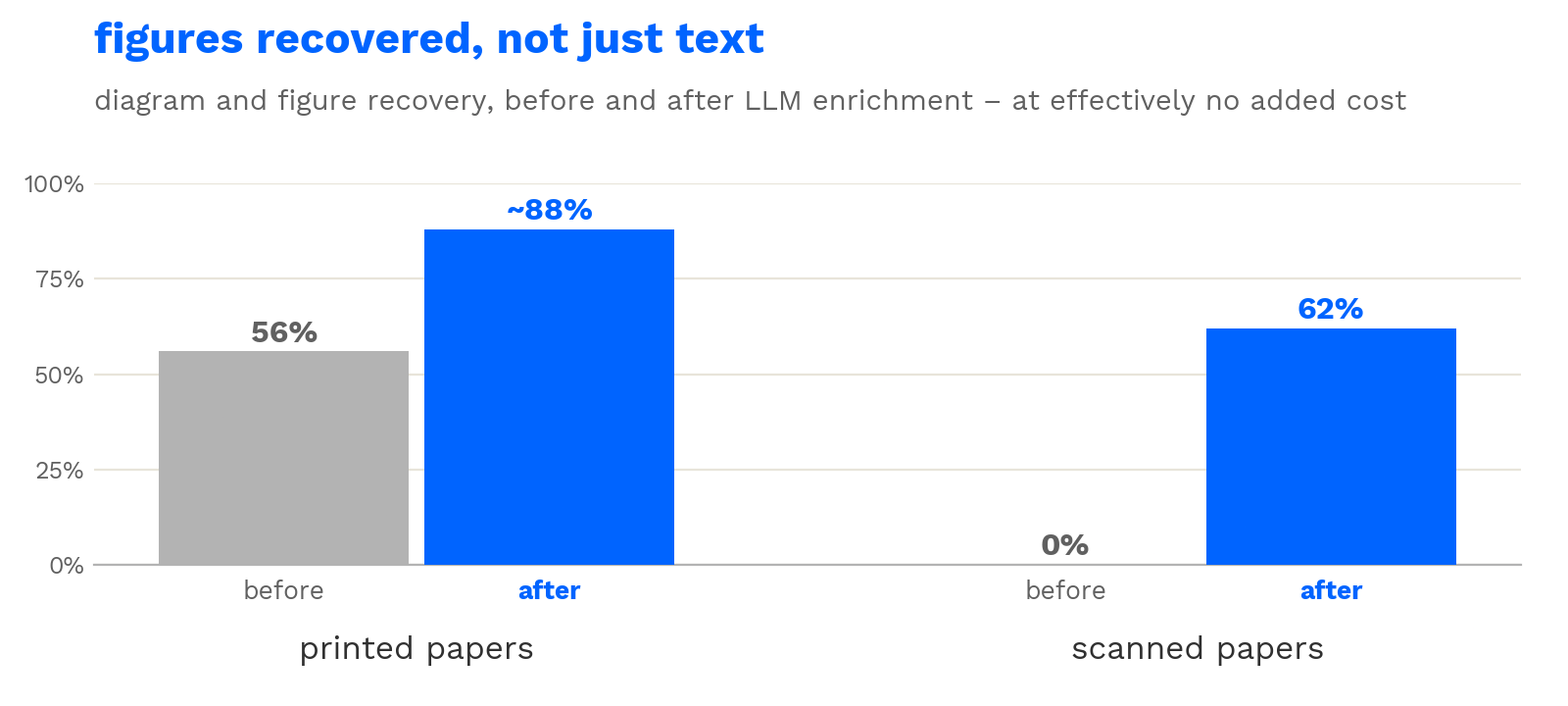
Claude Haiku, the smallest Claude model we tested, met the accuracy bar on clean papers at roughly a quarter of the enrichment cost of the top-accuracy configurations, and beat every non-Claude model we benchmarked. So the pipeline routes pages to Haiku by default and escalates figure-heavy pages to Claude Sonnet, reading the page itself rather than relying on generic prompt routing. Beyond the original build, Daemon's ongoing support work took figure and diagram recovery from just over half to nearly nine in ten, and made scanned and photographed papers usable inputs for the first time, at effectively no added cost. Scored question by question against the ground-truth dataset, the pipeline captures over 95% (F1 0.957) of exam content correctly on clean printed papers, at about $0.54 (around 40p) and one to two minutes for a typical 12-page paper.
Built for trust, live in production
The pipeline runs in Brainboost AI's AWS environment in London, keeping data within the country: important for compliance with stringent standards that are the norm in the education sector. Amazon Textract handles layout extraction, and all model inference runs through Amazon Bedrock - a flexible pipeline enabling accuracy and cost optimising configurations such as Claude Haiku by default, Claude Sonnet on figure-heavy pages - with processing kept within UK and European regions for school data residency. It has been live in production since June 2026, within weeks of handover. With the full evaluation framework codebase, every release and improvement can be scored against the ground-truth dataset before it ships: code and framework are Brainboost AI's to own and extend.
Augmented AI Enabled Engineering
Throughout the development lifecycle, Daemon paired Claude with its own engineers. Claude was leveraged to draft code, generate visualisations, and help to coordinate across experiments. Humans in the loop everywhere, with Claude pivotal in producing a rigorously evaluated and productionisable result inside a short engagement window.
The Outcome
Value creation
- A new market made viable: Brainboost AI's proposition for schools works because a paper becomes structured content in one to two minutes for about $0.54 (around 40p), instead of an estimated three to five hours of skilled manual work. At manual rates, a full-time person could prepare perhaps eight to twelve papers a week; the pipeline matches that in minutes. Any paper a school cares about becomes assignable, AI-assisted content as Brainboost AI scales across dozens of UK schools, with Maths and English live today and a roadmap into the sciences.
- Accuracy that protects revenue: Incorrectly extracted questions cannot be stored or categorised well - and cannot form the basis of a coherent AI tutoring experience. Over 95% extraction accuracy (F1 0.957) on clean printed papers, scored against hand-checked extractions, protects the product promise as the offering to schools scales.
- The biggest subjects unlocked: diagram-heavy papers in maths and the sciences are the highest-volume exam markets, and photographed papers are how students actually work. Both are now supported inputs.
Operational value
- Pennies per paper: about $0.54 (around 40p) for a typical 12-page paper, with the model mix tuned so the smallest model does the work wherever quality allows.
- Lower lifetime cost of ownership: Brainboost AI runs the evaluation framework in-house, so new exam boards and model upgrades are validated by their own team, with no consultancy dependency for quality assurance.
Testimonial from Brainboost AI
"Daemon built this for us as a proof of concept but very quickly landed it into production, a key feature for our target market: schools, which need their data to stay in the UK, and need high quality extraction to make the feature feasible for them."
Onder Altan, CTO, Brainboost AI
Related Resources
Machine Learning & AI / Case Study
Investment to Impact: Transforming "Enthusiastic Frustration into strategic momentum for Specsavers' AI-Enabled SDLC

Cloud / Case Study
Smart Cloud migration you can trust

Cloud / Case Study
Managed Service transition during the COVID-19 pandemic